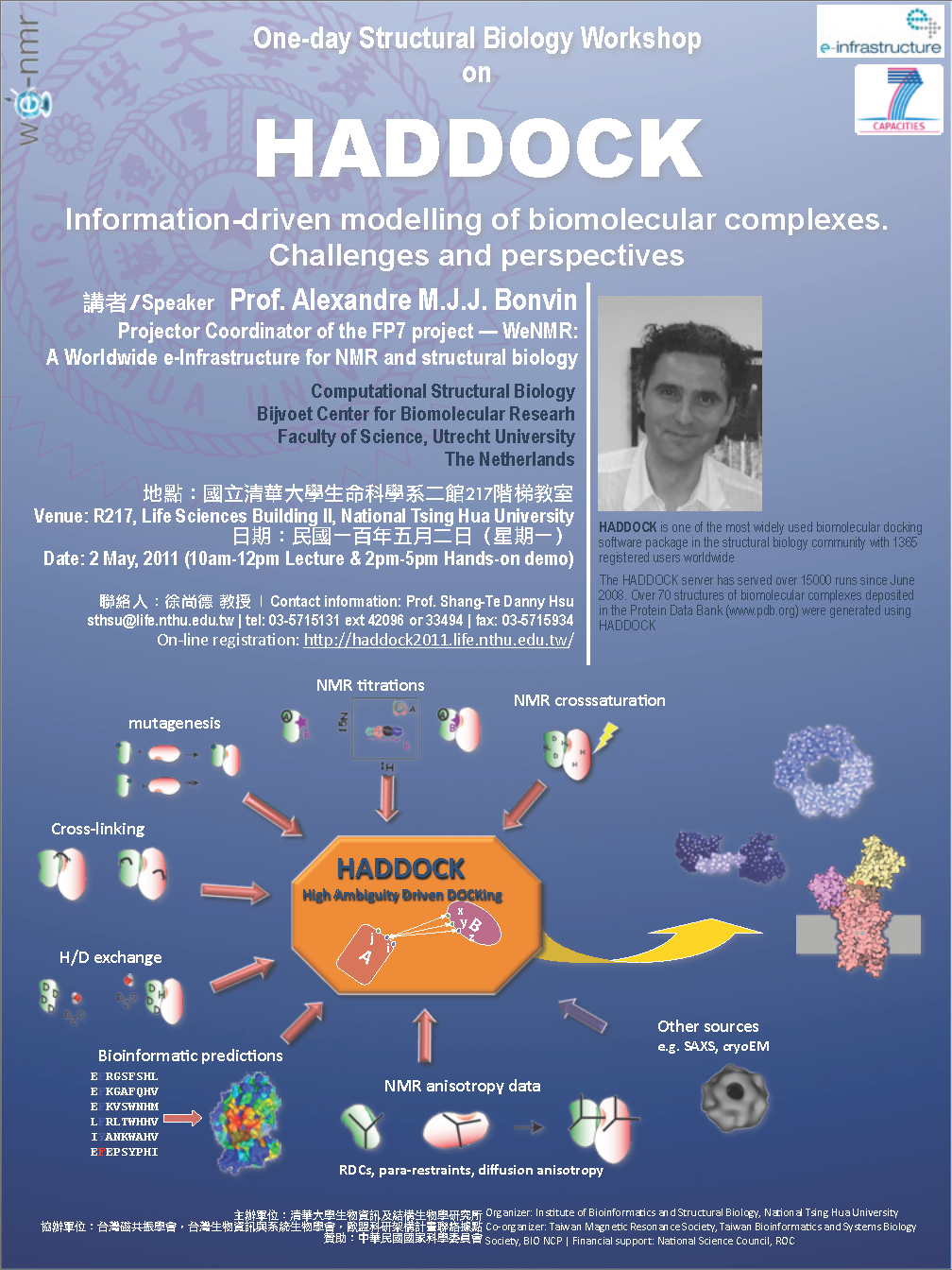
HADDOCK研討會 / Workshop on HADDOCK
講者/Speaker:Prof. Alexandre M.J.J. Bonvin
荷蘭烏特列支大學Bijvoet生物分子研究中心 / Bijvoet Center for Biomolecular Research, Utrecht University, the Netherlands
地點:國立清華大學生命科學系二館217階梯教室及220生物資訊電腦教室
Venue: R217 & R220, Life Science Building II, National Tsing Hua University
時間:民國一百年五月二日(星期一)上午十點至下午五點
Date: Monday 2 May 2011 10am-5pm
報名日期:2011-03-31~2011-05-01
感謝各位踴躍的報名。由於目前統計報名人數已超出該研討會當天下午使用電腦教室所能提供的座位數,因此從今日起報名者將無法參與下午的實作課程。我們將在日後定期安排同樣的研討會提供研究人員參與。謝謝您的耐心與諒解。
研討會簡介
HADDOCK (High Ambiguity Driven biomolecular DOCKing) 是由荷蘭烏特列支(Utrecht)大學Bijvoet生物分子研究中心Alexandre Bonvin教授於2003所開發的生物分子對接(docking)模擬軟體,為結構生物學領域中最廣泛被運用的套裝軟體之一,全球註冊支使用者已超過一千兩百人。HADDOCK除了可安裝在個人電腦上使用,也可利用HADDOCK伺服器(http://www.haddocking.org/) 進行模擬。HADDOCK伺服器自2008年六月啓用以來已提供15000+模擬計算。蛋白質結構資料庫Protein Data Bank中逾七十個生物分子錯合物的結構計算也引用HADDOCK所提供的技術。
自2010年十一月起,Bonvin教授開始主導為期三年的歐盟FP7計劃WeNMR (A worldwide e-Infrastructure for NMR and structural biology; http://www.wenmr.eu )。希望藉由八個歐洲研究團隊的合作,整合核磁共振光譜學及小角度散射等結構生物學上所普遍用到的計算軟體,並透過全球格網GRID資源,以提供高效能的計算資源。
本次研討會將在上午由Bonvin教授針對生物巨分子錯合物之結構計算進行專題演講,講題為“Information-driven modelling of biomolecular complexes. Challenges and perspectives“。下午將利用生科系生物資訊教室之電腦或個人筆記型電腦透過網路進行三小時的HADDOCK實作示範操作。唯因生物資訊教室空間有限,若報名人數過多,將以實驗室為單位作篩選並另行通知。
如需更進一步的資訊,請洽詢:
清大生資所徐尚德教授 (sthsu_at_life.nthu.edu.tw)
聯絡電話:03-5742096
programme outline
HADDOCK is a biomolecular docking software package developed by Prof. Alexandre Bonvin at the Bijvoet Center for Biomolecular Research, Utrecht University, the Netherlands. It is one of the most widely used docking programme in the structural biology community with over 1200 registered users world-wide. HADDOCK is freely available to academic users for local installation. The HADDOCK server (http://www.haddocking.org/ is also available to online users. Since June 2008, the HADDOCK has served over 15000 runs. Over 70 structures of biomolecular complexes deposited in the Protein Data Bank were generated using HADDOCK.)
Since November 2011, Prof. Bonvin is the coordinator of the EU-funded FP7 project WeNMR with a team of eight European research groups. The objective of WeNMR is to optimize and extend the use of the NMR and SAXS research infrastructures through the implementation of an e-infrastructure based on GRID in order to provide the user community with a platform integrating and streamlining the computational approaches necessary for NMR and SAXS data analysis and structural modelling.
In this one-day workshop, Prof. Bonvin will in the morning deliver a lecture entitled “Information-driven modelling of biomolecular complexes. Challenges and perspectives”followed by a hands-on demonstration of HADDOCK in the afternoon (2-5pm). Participants can either use the computers in the bioinformatics classroom or their own laptop to follow the demonstrations online. There will be a limited number of positions available for the demonstration in the afternoon due to the space restriction. A selection will be made on the basis of research group affiliation.
For further information, please contact Prof. Shang-Te Danny Hsu, Institute of Bioinformatics and Structural Biology, National Tsing Hua University (sthsu_at_life.nthu.edu.tw)
時間表
|
時 間
|
內 容
|
說 明
|
地點
|
|
10:00 - 12:00
|
Lecture by Prof. Alexandre Bonvin
|
Information-driven modelling of biomolecular complexes. Challenges and perspectives
|
LSII R.217
|
|
14:00 - 17:00
|
Hand-on demo of HADDOCK
|
|
LSII R.220
|
Information-driven modelling of biomolecular complexes.
Challenges and perspectives
Alexandre M. J. J. Bonvin
Computational Structural Biology, Bijvoet Center for Biomolecular Research, Faculty of Science, Utrecht University, 3584CH, Utrecht, The Netherlands. Email: a.m.j.j.bonvin@uu.nl
With the presently available amount of genetic information, a lot of attention focuses on systems biology and in particular on biomolecular interactions. Considering the huge number of such interactions, and their often weak and transient nature, conventional experimental methods such as X-ray crystallography and NMR spectroscopy will not be sufficient to gain structural insight into those. A wealth of biochemical and/or biophysical data can however easily be obtained for biomolecular complexes. Combining these data with docking, the process of modeling the 3D structure of a complex from its known components, should provide valuable structural information and complement the classical structural methods.
We have developed for this purpose a data-driven docking approach called HADDOCK (High Ambiguity Driven protein–protein DOCKing) (http://www.nmr.chem.uu.nl/haddock), which is now also available as web server (http://www.haddocking.org/). HADDOCK distinguishes itself from ab-initio docking methods in the fact that it encodes information from identified or predicted protein interfaces in ambiguous interaction restraints (AIRs) to drive the docking process. Flexibility is accounted for in different ways during the docking, which allows to model (small) conformational changes taking place during complex formation.
In my talk I will present the current status of HADDOCK development and illustrate it with examples from our laboratory together with results from our participation to the blind docking experiment CAPRI (Critical Assessment of PRedicted Interactions) (http://capri.ebi.ac.uk). Finally I will discuss some of the still open challenges in this field.
References:
Dominguez C, Boelens R and Bonvin AMJJ (2003). HADDOCK: A protein-protein docking approach based on biochemical or biophysical information. J Am Chem Soc 125 1731-1737.
de Vries SJ and Bonvin AMJJ (2008). How proteins get in touch: Interface prediction in the study of biomolecular complexes. Curr. Pept. Prot. Research 9, 394-406.
de Vries SJ, van Dijk, M and Bonvin AMJJ (2010). The HADDOCK server for data-driven biomolecular docking. Nature Protocols5, 883-897.
de Vries, SJ, Melquiond ASJ, Kastritis PL, Karaca E, Bordogna A, van Dijk M, Rodrigues JPGLM. and Bonvin AMJJ (2010). Strengths and weaknesses of data-driven docking in CAPRI. Proteins: Struc. Funct. & Bioinformatic 78, 3242-3249 (2010).
Karaca E, Melquiond, ASJ, de Vries SJ, Kastritis PL and Bonvin AMJJ (2010). Building macromolecular assemblies by information-driven docking: Introducing the HADDOCK multi-body docking server. Mol. Cell. Proteomics 9, 1784-1794.
van Dijk M and Bonvin AMJJ (2010). Pushing the limits of what is achievable in protein-DNA docking. Benchmarking HADDOCK's performance. Nucl. Acid Res. 38, 5634-5647.
Kastritis PL and Bonvin AMJJ (2010). Are scoring functions in protein-protein docking ready to predict interactomes? Clues from a novel binding affinity benchmark. J. Proteome Research, 9, 2216-2225.
主辦單位:清華大學生物資訊及結構生物學研究所
協辦單位:台灣磁共振學會,台灣生物資訊與系統生物學會,歐盟科研架構計畫聯絡據點
贊助:中華民國國家科學委員會